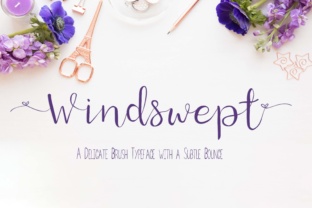
Windswept: A Delicate Brush Font with Modern Bounce
There is a quiet confidence in a typeface that feels both familiar and fresh. Windswept brings exactly that kind of presence to your work. At first glance, it reads as a delicate brush font with a subtle bounce — a combination that nods to traditional feminine typeface aesthetics while feeling thoroughly contemporary. The letters do not sit rigidly on a baseline. They sway, they lift, they settle back down, mimicking the natural rhythm of handwriting. That sense of motion is what makes Windswept stand out in a crowded field of display fonts. It does not shout for attention. It earns it through charm and poise.
For anyone who creates content, designs visuals, or builds brands, finding a typeface that balances softness with utility can feel like a small victory. Windswept offers exactly that balance. It is expressive enough to carry emotion, but structured enough to remain legible and versatile. This article explores what makes Windswept worth your time and how you can put it to work across real projects.
What Makes Windswept Different
Brush fonts often fall into one of two camps. They are either aggressively rough, mimicking the heavy stroke of a paintbrush, or they are overly polished, losing the human touch entirely. Windswept avoids both extremes. The strokes are light and airy, with a bounce that feels intentional rather than erratic. Each character carries a slight tilt, a variation in weight, and a gentle curve that gives the font its signature warmth.
The feminine quality of Windswept is not about decoration. It comes from the flow of the letters — the way descenders loop with grace, the way ascenders reach upward without stiffness. This makes the typeface particularly effective for projects where you want to communicate approachability, care, or elegance without veering into the ornate. It is modern because it respects the principles of readability. It is delicate because it values rhythm.
- Subtle bounce: The baseline variation adds movement without distracting from the message.
- Balanced stroke contrast: Thin and thick transitions feel natural, not forced.
- Legible even at display sizes: The openness of the letterforms keeps words clear.
Creative Possibilities Across Audiences and Platforms
The real strength of Windswept lies in its adaptability. Different users will find different reasons to reach for it, and it performs well across a surprising range of formats.
For Designers and Creative Professionals
If you work in branding, packaging, or editorial design, Windswept can serve as a headline or accent typeface that softens a layout. Pair it with a clean sans-serif body font to create contrast. The bounce in Windswept adds a human layer to otherwise structured compositions. Consider using it for:
- Logo wordmarks for lifestyle, beauty, or wellness brands.
- Invitation suites where warmth and personality matter more than formality.
- Social media graphics that need a handcrafted feel without custom lettering.
A practical example: imagine a small skincare line launching a new serum. Using Windswept for the product name on the label communicates gentleness and natural care. The bounce mirrors the organic textures of the ingredients. Pair it with a muted color palette, and the typography does the emotional work.
For Small Business Owners and Entrepreneurs
You do not need to be a trained designer to benefit from Windswept. If you run a boutique, a café, a stationery shop, or an online store, your visual identity matters. Customers make snap judgments based on your branding. A typeface like Windswept helps you look intentional without feeling corporate.
- Use it on your website hero section to establish a tone of warmth.
- Add it to product packaging tags or thank-you cards.
- Incorporate it into your email newsletter headers for consistency.
One real-world approach: a small bakery uses Windswept for its menu boards and social media posts. The bounce of the letters echoes the irregular shapes of artisan pastries. Customers comment that the visuals feel as honest as the food. That is the kind of connection a font can help build.
For Bloggers, Educators, and Content Creators
Content is not just about what you say. It is about how it looks. Windswept works well for blog post titles, course materials, and video thumbnails where you want to signal a friendly, approachable tone. It pairs naturally with neutral backgrounds and soft imagery.
- Title slides for online workshops or presentations.
- Quote graphics for Instagram or Pinterest that rely on visual appeal.
- Printable worksheets, planners, or guides that benefit from a hand-lettered feel.
An educator creating a mindfulness journal might use Windswept for section headers. The font itself suggests calm and reflection. The bounce prevents the layout from feeling too rigid or clinical.
Practical Project Ideas to Explore
Inspiration is most useful when it turns into action. Here are several project ideas that make good use of Windswept’s strengths. Each one is realistic enough to start today.
- Brand refresh for a personal blog. Replace your current header font with Windswept. Keep your body text simple. Notice how the tone shifts. You may find that readers respond differently to content that looks more personal.
- Seasonal product tags. Whether you sell candles, soaps, or clothing, add Windswept tags with handwritten-style notes. The font gives the impression of care and small-batch attention.
- Social media quote series. Choose a weekly theme and create quote cards using Windswept. Keep the backgrounds minimal. Let the typography carry the emotion.
- Digital invitation suite. For a baby shower, bridal brunch, or garden party, Windswept is a natural fit. The bounce adds a celebratory feel that formal fonts cannot replicate.
- Product packaging accent. Even a single word in Windswept — like “handmade” or “love” — on a label can elevate the entire package.
Each of these ideas works because Windswept does not need heavy styling to shine. The font itself does the work.
Adapting Windswept for Different Contexts
No typeface works everywhere, and Windswept has its sweet spots. Knowing how to adapt it for different contexts will help you avoid missteps.
Digital vs. Print
Windswept performs well on screen, especially at medium to large sizes. For small body text, the bounce can make reading more difficult, so reserve it for headings, subheadings, and accent text. In print, the subtle stroke variations come through beautifully on uncoated paper, which absorbs ink softly and enhances the hand-drawn quality.
If you are designing for mobile, test your layout at actual device sizes. The bounce should be visible but not overwhelming. A good rule of thumb: if the reader notices the font before the message, pull back the size or spacing.
Pairing with Other Fonts
Windswept pairs well with neutral sans-serifs, clean slab serifs, and even other script fonts if you keep one as the primary voice. Avoid pairing it with fonts that are equally busy. That competition creates visual noise. Instead, let Windswept lead and choose a body font that stays out of its way.
- Good pairings: Open Sans, Lato, Roboto, Montserrat Light, or Cardo.
- Avoid: other bounce scripts, heavy brush fonts, or decorative serifs in the same layout.
Color and Background Considerations
Windswept works best on solid or subtly textured backgrounds. Busy patterns compete with the bounce. Soft pastels, warm neutrals, and muted earth tones enhance the font’s delicate quality. Dark backgrounds with light text can look striking if you keep the letter spacing generous. Metallics or foil effects in print also pair well with Windswept for premium applications.
Keeping Results Clear and Audience-Friendly
Typeface choice is always about the reader. No matter how beautiful Windswept looks, it must serve the message. Here are practical ways to keep your output effective.
- Check legibility at different sizes. What looks graceful at 48 points may become unclear at 24 points. Always test your final output.
- Limit your use. One or two words in Windswept can have more impact than an entire paragraph. Use it as a highlight, not a wall of text.
- Mind your spacing. Letter spacing and line height matter more with fonts that have a bounce. Tight spacing can make the bounce look cramped. Give the letters room to breathe.
- Stay consistent. If you use Windswept in your branding, apply it across all touchpoints. Consistency builds recognition and trust.
Audiences may not consciously notice typography choices. But they will notice when something feels right. That is the quiet power of a well-chosen font.
Why Windswept Belongs in Your Toolkit
Typefaces are tools. Some are hammers — loud, direct, built for impact. Windswept is more like a fine brush. It works best when you want to add nuance, texture, and a human touch. It does not try to be everything to everyone. It excels in the spaces where warmth matters: personal brands, soft luxury, heartfelt communication, and creative work that needs a sense of motion without chaos.
If you have been searching for a typeface that feels feminine without being frilly, modern without being cold, and elegant without being fussy, Windswept is worth the download. Try it on a small project first. Let the bounce find its rhythm in your layout. You may find that one use leads to another. That is the mark of a font that earns a lasting place in your workflow.
Typography choices shape how people experience your work. Windswept gives you a way to shape that experience with subtlety and intention. And in a world of loud visuals, subtlety is often the most memorable thing of all.