What s My Age Again: A Sassy All-Lowercase Font for Creative Projects
When a typeface deliberately breaks the rules of conventional typography, it often finds a loyal audience among designers and makers who value personality over polish. What s My Age Again is one such font—a deliberately all-lowercase, sassy typeface that swaps ordinary punctuation for expressive symbols. It does not attempt to be neutral or versatile in the traditional sense. Instead, it stakes its reputation on attitude, irreverence, and a raw, hand-drawn feel that resonates with a wide range of creative applications.
For professionals, entrepreneurs, and creators who need to convey informality, humor, or a touch of rebellion, What s My Age Again offers something that many polished fonts lack: a voice that sounds human. This article examines what this typeface actually delivers, where it excels, and who should consider adding it to their toolkit.
Understanding What s My Age Again and Its Unique Personality
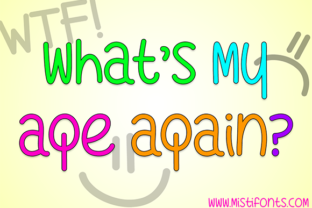
At its core, What s My Age Again is a display font that embraces an intentionally messy, lowercase-only aesthetic. Every character sits below the cap height, and there are no uppercase alternates. This is not a limitation but a deliberate design choice. The font’s name itself hints at a playful refusal to grow up—a badge of youthfulness and defiance.
The most distinctive feature, however, is the way it handles common punctuation. An underscore (_) renders as a smiley face, a vertical bar (|) becomes a sad face, and an asterisk (*) turns into a “WTF” symbol. These substitutions are hardcoded into the character map, meaning that whenever a user types those keys, the symbol appears instead of the expected punctuation. This gives the font a built-in emotional shorthand that can be used to add flavor to headlines, captions, or short messages.
The overall appearance is rough, slightly irregular, and reminiscent of marker on paper. Strokes vary in thickness, and letterforms are not perfectly aligned in width or height. This organic quality is central to the font’s appeal. It does not try to hide its hand-drawn roots—it celebrates them.
Key Characteristics That Define the Font
- All lowercase: Every letter is designed at one height, with no uppercase variants. This creates a uniform, casual rhythm.
- Symbolic punctuation: The underscore, vertical bar, and asterisk produce emotive icons instead of standard marks. This is a rare feature that can serve as a creative shorthand.
- Sassy, informal tone: The letterforms are deliberately uneven, with a “don’t care” attitude that suits youthful or rebellious branding.
- Limited character set: Basic letters, numbers, and a handful of punctuation are included. Advanced typographic features such as ligatures, stylistic sets, or kerning tables are minimal.
These characteristics make What s My Age Again a specialist tool. It is not built for body text or long-form reading. Instead, it shines in contexts where the message is short, the mood is light, and the audience expects a touch of personality.
Practical Value for Design and Craft Projects
The font’s primary strength lies in its ability to inject humor and informality into visual communication. For craft projects such as greeting cards, custom T-shirts, stickers, or scrapbook layouts, What s My Age Again feels like a natural fit. The smiley and sad face symbols allow for quick emotional cues without adding separate graphic elements. A simple line like “bad day *” in this font immediately communicates frustration in a way that plain text cannot.
For digital designers working on social media graphics, YouTube thumbnails, or Instagram stories, the font’s rough edges stand out against the polished sans-serif fonts that dominate most platforms. It works well when paired with a clean, neutral typeface for contrast—for example, using What s My Age Again for the main headline and a simple geometric sans for the supporting copy.
Small business owners and freelancers who want a distinctive brand voice—especially in niches like streetwear, alternative culture, food trucks, or youth-oriented services—may find the font helps them communicate authenticity. It suggests that the brand does not take itself too seriously, which can be an effective positioning strategy.
Real-World Scenarios Where the Font Performs Well
- Event posters and flyers: A school dance, a band show, or a community art sale can benefit from the font’s energetic, informal look.
- Merchandise mockups: T-shirt prints, mugs, and phone cases featuring short phrases like “hangry _” or “monday |” gain a quick emotional connection.
- Digital stickers and emoji-like decorations: Using the symbolic punctuation in chat apps or graphics adds a layer of playfulness.
- Blog and newsletter headers: A personal blog or a humor-oriented newsletter can use this font in its banner or section titles to reinforce a casual tone.
In these uses, the font does not need to be highly legible at small sizes—it just needs to convey attitude. And it does that reliably.
Usability, Quality, and Technical Considerations
From a technical perspective, What s My Age Again is a standard OpenType or TrueType font that installs like any other. It works across major design software (Adobe Creative Suite, Affinity, Canva, etc.) and on both Windows and macOS. However, users should be aware of a few practical limitations.
First, the font’s readability degrades quickly at smaller point sizes. Below 14–16 pixels on screen, the irregular stroke widths can make letters appear muddy or hard to distinguish. It is best used at medium to large sizes where the rough edges become a feature, not a defect. Second, because there is no uppercase set, the font lacks the visual hierarchy that comes from mixing case. Long strings of text in all lowercase can feel monotonous, so the font is best reserved for short headings or single words.
Third, the symbolic punctuation may cause confusion in certain workflows. If a user accidentally types an underscore in a file name or URL while this font is active, the displayed symbol might not match the intended meaning. This is a minor issue but worth noting for anyone using the font in production environments.
Flexibility and Consistency Across Applications
One of the font’s strengths is its consistency. The same rough texture and “sassy” tone persist across every character, giving projects a cohesive feel. This is especially valuable for branding materials where a single visual voice must carry through multiple touchpoints—from a website header to a sticker to a printed tag.
However, flexibility is limited. The font does not offer weight variations (no bold, italic, or condensed versions). Designers who need hierarchical emphasis must rely on other methods, such as changing size, color, or surrounding font choice. This is not a barrier for most projects, but it does mean that What s My Age Again works best as a solo accent rather than a full typographic system.
Who Benefits Most from What s My Age Again
Based on its characteristics, the font is most useful for:
- Creatives and hobbyists who work on personal projects like journaling, scrapbooking, or DIY crafts and want an expressive typeface without a steep learning curve.
- Small business owners in casual or youth-oriented industries (cafes, vintage stores, tattoo parlors, comic shops) who need to telegraph a fun, approachable brand identity.
- Educators and content creators designing materials for younger audiences—school newsletters, classroom posters, or YouTube channel art—where a playful tone is appropriate.
- Marketers and social media managers experimenting with visual humor to increase engagement, especially on platforms like Instagram, TikTok, or Pinterest where typography can serve as a hook.
Conversely, the font is less suitable for corporate communications, legal documents, any context requiring formal typography, or projects that demand high readability at very small sizes. It is a niche tool, and that is perfectly fine.
Professional Observations and Recommendations
In my experience evaluating tools for creative use, What s My Age Again occupies a specific and valuable space. There are many display fonts that aim for hand-drawn authenticity, but few integrate emotional symbols as directly into the typing experience. This feature alone can save time and add a layer of spontaneity that separate emoji insertions cannot replicate.
For optimal results, treat the font as you would a bold italic or a script accent—use it sparingly and with intention. A headline set in What s My Age Again can anchor a design, but body text or footnotes should use something more legible. Pair it with a clean, neutral sans-serif like Helvetica Now, Montserrat, or Inter to balance the roughness.
Another practical recommendation: test the font at the exact size and medium you plan to use. Because its legibility drops off quickly, always preview on your target output (screen resolution, print type, etc.) before finalizing a design. This will help avoid surprises.
Long-Term Value and Considerations
Fonts with strong personalities often face a question of longevity. Will What s My Age Again feel dated after a few years? Possibly—trends in typography come and go, and the deliberately messy, “hand-lettered” look has been popular for a decade but may eventually fatigue. However, the font’s core emotional utility—expressing sarcasm, frustration, or joy through embedded symbols—has a timeless appeal as long as digital communication continues to rely on text.
For a one‑time purchase (the font is typically priced in the range of $15–$30 from independent foundries), the investment is modest. Even if used for only a handful of projects, the cost per use can be negligible. For professionals who produce a high volume of casual content—like influencers, freelancers, or small design studios—the font can quickly pay for itself in time saved and engagement gained.
When the Font May Not Be the Right Choice
Every tool has its limits. What s My Age Again is not a workhorse for multilingual projects, as it may lack accented characters or non‑Latin support. It also cannot be used effectively in very formal or conservative brand contexts. If your audience expects elegance or authority, this font will undermine that effort. Additionally, because the symbolic punctuation is non‑standard, collaborating with others who do not have the font installed will cause those characters to fall back to default glyphs (underscore, vertical bar, asterisk), which may change the intended meaning.
Making the Decision: Is What s My Age Again Right for Your Project?
To determine whether this font fits your needs, consider these questions:
- Does your project benefit from an informal, youthful, or rebellious tone?
- Are you working with short text—headlines, single words, short phrases?
- Do you need to convey emotion (happiness, sadness, exasperation) directly through type without adding separate icons or images?
- Is your audience comfortable with a break from traditional typographic norms?
If you answered yes to most of these, What s My Age Again is likely a strong addition to your type library. If you answered no, you may be better served by a more neutral display font that offers similar hand-drawn texture without the lowercase‑only constraint or the symbolic substitutions.
Ultimately, What s My Age Again succeeds because it does not try to be everything. It embraces a specific, sassy, lowercase identity and gives users a simple way to inject that spirit into their work. For anyone looking to add a bit of irreverent charm to their next craft project, social graphic, or small‑brand design, this font delivers exactly what its name promises—a reminder not to take it all so seriously.