Technically but Not Actually: A Handwritten Font That Brings Personality to Real Projects
Every now and then you stumble across a font that doesn't just look good on a specimen sheet—it actually changes how people respond to what you've made. Technically but Not Actually is one of those typefaces. It's quirky, handwritten, and deliberately imperfect. And that imperfection is exactly what makes it useful across a surprising range of projects.
Whether you're designing a product label, building a personal brand, or putting together materials for a community workshop, this font has a way of making things feel less polished and more human. And in a world saturated with sleek, corporate typography, that human quality matters more than many people realize.
What Technically but Not Actually Actually Is
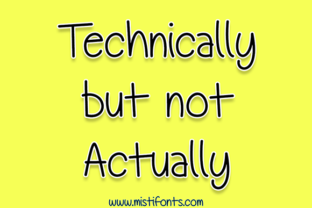
At its core, this is a handwritten font with a distinct personality. The letterforms have a slightly uneven, sketch-like quality. Strokes vary in thickness. Characters don't sit perfectly on the baseline. Some letters lean a little. Others feel like they were drawn quickly, almost carelessly.
But here's the thing—that carelessness is intentional. Technically but Not Actually captures the energy of handwriting without the inconsistency of an actual hand. You get the warmth and spontaneity of pen on paper, but with the reliability of a digital font. No smudges, no misspellings, no running out of ink halfway through a word.
For anyone who has ever tried to recreate handwritten aesthetics digitally, you already know how frustrating it can be. Brush fonts often feel too deliberate. Script fonts can feel overly romantic. Hand-drawn letters take forever to produce and even longer to digitize. This font sidesteps all of that by landing somewhere in between deliberate design and genuine looseness.
Where People Actually Use This Font
The real test of any design resource isn't how it looks in a portfolio—it's whether people find ways to use it in their everyday work. Here are some of the most common scenarios where Technically but Not Actually ends up being the right choice.
Product Packaging and Labels
Small-batch food makers, soap crafters, and independent candle sellers all face a similar challenge: how do you make a product look handmade without looking amateurish? The answer often comes down to typography. A font that looks like someone wrote the ingredients by hand can communicate care, small-scale production, and authenticity. But it has to be readable. It has to hold up at different sizes. And it needs to work across multiple products in a line.
Technically but Not Actually works well here because it's legible without being sterile. On a jar of honey or a box of granola, it suggests a person was involved in making this—not just a machine. For a soap label, it can convey the idea of small-batch craftsmanship. And because the font has a slightly rough edge, it photographs well for social media, which is where many small brands do most of their selling.
Social Media Graphics and Content Creation
Content creators who post regularly know the struggle of making each graphic feel fresh. Templated designs with standard fonts start looking repetitive after a few weeks. Switching to a font with more personality can breathe new life into a feed without requiring a full redesign.
Instagram quotes, Pinterest pins, TikTok thumbnails, and Facebook cover images all benefit from typography that feels casual. Technically but Not Actually works especially well for content that centers on personal stories, reflections, or informal advice. It doesn't feel like a brand trying to sell you something. It feels like someone jotting down a thought and sharing it.
Workshop Materials and Educational Handouts
Teachers, workshop facilitators, and course creators often rely on printed handouts or digital PDFs. When the material is dense, a playful font can lighten the mood. When the subject is creative, a handwritten font reinforces that creativity is welcome.
I've seen this font used in everything from poetry workshop prompts to nature journaling guides to recipe cards for cooking classes. What makes it work in these contexts is that it doesn't feel like a textbook. It feels like something a thoughtful instructor put together by hand. For adult learners, that can reduce the formality of the setting and make the material feel more accessible.
Personal Branding and Small Business Identity
Freelancers, consultants, and solopreneurs often struggle with branding because their logo or business card needs to represent them as a person—not just a company. A handwritten font can be a core part of that identity. It signals approachability. It suggests that the person behind the business is real.
Technically but Not Actually works as part of a logo, but it also shines in less obvious places: email headers, invoice templates, proposal covers, and even the thank-you notes that go out with every order. For a life coach, a wellness blogger, or a freelance illustrator, this font can become a consistent thread across touchpoints.
Different Users, Different Benefits
Not everyone reaches for a quirky handwritten font for the same reasons. The way different people use Technically but Not Actually reveals a lot about what this font actually offers.
Small business owners tend to use it for differentiation. When every competitor in your niche is using the same minimalist sans-serif, switching to a warm handwritten font makes your brand stand out. It's not about being louder—it's about being more memorable.
Hobbyists and makers appreciate how the font elevates their work without requiring design skills. Someone who makes pottery on weekends doesn't want to spend hours learning typography. They want a font that already looks like it belongs on a handmade mug. This font does that.
Marketers and content strategists use it to reduce friction. A headline in a playful font can lower the perceived seriousness of a message. That's useful when you're asking people to try something new or consider a different perspective. It disarms skepticism without trying too hard.
Educators and facilitators often choose this font because it signals warmth. Participants in a workshop or online course respond differently to materials that look like they were made with care. It builds trust before a single word is read.
Bloggers and publishers use it for pull quotes, section headers, and callout boxes. Sprinkled sparingly throughout a longer article, it breaks up the visual monotony and draws attention to key ideas.
What to Consider Before Using It
No font works everywhere. Technically but Not Actually has a strong personality, and that personality can work against you if it's used in the wrong context.
Consider readability at small sizes. Handwritten fonts with inconsistent stroke widths can become difficult to read below a certain point size. If you're planning to use this font for body text in a printed brochure or a mobile web layout, test it first. It often works best at medium to large sizes where the quirks are visible but not overwhelming.
Think about pairing. A font this expressive doesn't play well with other expressive typefaces. Pair it with a neutral, clean sans-serif for contrast. Let Technically but Not Actually be the voice, and let your supporting font be the structure.
Consider your audience's expectations. For a legal document, a financial report, or a medical brochure, this font would feel wildly out of place. But for a creative brief, a workshop agenda, or a product launch page, it can feel exactly right.
License matters too. If you're using this font in commercial projects—products for sale, branding for paying clients, merchandise—make sure you have the proper license. Many handmade fonts have restrictions on commercial use, and assuming otherwise can lead to problems down the road.
Testing Before Committing
The best way to decide if this font is right for your project is to test it in context. Drop it into a mockup of your label, your website header, or your handout. Look at it at the actual size people will see it. Print it out if possible. Sometimes a font that looks charming on screen feels different on paper, and vice versa.
Ask someone unfamiliar with the project to read a sentence or two. If they pause or squint, you may need to adjust size, spacing, or placement. Handwritten fonts can be surprisingly polarizing—some people love the looseness, others find it distracting. Your audience's comfort should guide your choices.
Making the Most of the Imperfection
The real value of Technically but Not Actually isn't in its technical precision. It's in what that precision lacks—the sterile uniformity that makes so much digital design feel cold. By choosing a font that embraces inconsistency, you're making a statement. You're saying that this project was made by people, for people. And that message, when it lands, is powerful.
Use it where warmth matters. Use it where you want to be remembered. And use it where the goal isn't to impress with polish, but to connect with personality.