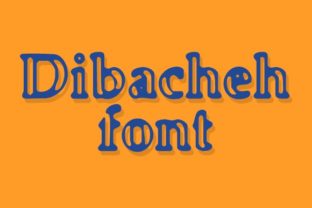
Dibacheh: The Outlined Bold Latin Serif Font That Demands Attention
When you are searching for a typeface that balances visual weight with a touch of tradition, few options feel as intentional as Dibacheh. This outlined bold Latin font, crafted in a serif style, offers something unusual: a design that reads as both sturdy and delicate, classic yet distinctly modern. For designers, marketers, and content creators evaluating display fonts, understanding what Dibacheh brings to the table—and where it might fall short—can help you decide whether it belongs in your next project.
What Makes Dibacheh Distinct
At first glance, Dibacheh presents as a bold serif typeface, but its defining characteristic is the outlined treatment applied to each letterform. Unlike solid bold serifs that rely on heavy ink traps and thick strokes for impact, Dibacheh achieves its presence through the interplay of open space and structured contours. The outline is not a mere afterthought; it is integral to the design, giving each character a sculpted, almost architectural feel.
The serifs themselves are not overly ornate. They follow a traditional bracketed structure, but the outlined treatment adds a layer of lightness that prevents the font from feeling heavy or cumbersome. This makes Dibacheh particularly effective at larger sizes, where the internal negative space becomes a visual feature rather than an absence. In display contexts—headlines, posters, banners, slogans—the font stands out because it does not shout; it invites the viewer to look closer.
Another distinguishing factor is the consistent stroke width within the outline. Many outlined fonts vary dramatically in thickness, creating an uneven appearance when scaled. Dibacheh maintains a disciplined uniformity, which contributes to its readability even when the outlined style might otherwise compromise legibility. This consistency is especially valuable in multilingual or multi-weight applications where visual harmony matters.
Comparing Dibacheh with Similar Font Styles
To appreciate where Dibacheh fits, it helps to consider the broader landscape of display serifs and outlined typefaces. The category of outlined serifs is relatively small compared to solid serifs or sans-serifs, but within that niche, designers choose between several approaches.
One common alternative is the inline serif, where a thin groove runs through the center of each stroke. Inline fonts share the outlined sensibility but typically create a two-line effect rather than a fully enclosed outline. Dibacheh differs by surrounding each letterform with a clear boundary, which gives it more visual separation from the background. This makes it more suitable for applications where the text needs to sit on busy imagery or textured surfaces.
Another category is the stencil serif, which breaks the letterforms into separate pieces for a mechanical or industrial look. While stencil fonts share the broken outline aesthetic, Dibacheh retains continuous, unbroken shapes. This continuity lends it a more formal, almost calligraphic quality that stencil fonts rarely achieve.
There are also solid bold serifs like classic Clarendon or Memphis styles. These offer maximum weight and presence but lack the airiness that Dibacheh provides. If your layout already includes heavy imagery or dense color blocks, a solid bold serif may compete for attention. Dibacheh, by contrast, creates a layered effect that can sit comfortably above a photograph or gradient without overwhelming the visual field.
Strengths of Dibacheh in Practice
One of the strongest arguments for choosing Dibacheh is its versatility within the display category. Because the outline is moderate rather than extreme, the font works across a range of sizes from around 36 points upward. At larger display sizes, the outline becomes a prominent design element. At smaller sizes, it reads as a slightly softened bold serif, retaining enough weight to remain legible.
Another strength is the font's compatibility with solid typefaces. Pairing Dibacheh with a simple sans-serif body text—think geometric or humanist styles—creates a clear hierarchy without clashing. The outlined serif draws the eye to headings and pull quotes, while the solid body text provides contrast. This pairing is particularly effective in editorial design, brand guidelines, and web hero sections.
Dibacheh also handles color fills and gradients unusually well. Because the outline defines each letter's boundary, you can apply a fill color to the interior—or leave it transparent to reveal a background image. This dual capability makes the font a practical choice for overlays, badges, and logo wordmarks where you want the type to interact with its surroundings rather than sit on top of them.
Where Dibacheh Faces Limitations
No typeface is a universal solution, and Dibacheh has constraints worth considering. The most obvious is legibility at small sizes. Below about 24 points, the outlined stroke becomes thin relative to the letterform, and counters can fill in or become indistinct. This is not a font for body copy, footnotes, or dense paragraphs. It is a display tool, and using it outside that range may frustrate readers.
Another limitation is the font's suitability for extended text. Because the outlined design creates a rhythmic pattern of open and closed spaces, reading long passages in Dibacheh can cause visual fatigue. The eye must constantly adjust between the outlined strokes and the negative space, which slows reading speed. For short phrases, slogans, or single words, this is not an issue. For headlines spanning multiple lines, test the spacing carefully.
There is also the question of brand tone. Dibacheh's sculpted, outlined serif style carries an inherent formality. It works well for luxury, heritage, editorial, and cultural contexts. However, for brands that want a casual, playful, or aggressive tone, the font may feel too refined. A heavy sans-serif or a hand-drawn style might communicate more directly in those cases.
Best-Fit Situations for Dibacheh
Knowing when to reach for Dibacheh can save time and improve outcomes. Based on its characteristics, the font shines in several specific scenarios.
- Large-format signage and posters: The outlined treatment ensures the text remains readable from a distance while adding a decorative element that plain bold fonts lack.
- Brand wordmarks and logotypes: For businesses in fashion, publishing, architecture, or hospitality, Dibacheh conveys a sense of established taste without being outdated.
- Editorial headlines and section titles: In magazines, annual reports, or online features, the font creates a clear visual break between sections and invites readers into the content.
- Product packaging and labels: When applied to premium products, Dibacheh's outlined serif suggests craftsmanship and attention to detail.
- Invitation and event materials: Formal events, gallery openings, and product launches benefit from the font's elegant but structured appearance.
When You May Need a Different Option
There are also clear signals that another font might serve you better. If your project involves long-form reading—white papers, blog articles, books—Dibacheh is not the right choice. You need a solid, readable body font designed for extended text, typically a serif like Georgia or a sans-serif like Open Sans.
If your brand identity leans toward minimalism or extreme modernity, the serif structure of Dibacheh might introduce an unwanted historical reference. A geometric sans-serif or a monolinear outline font could achieve a similar illuminated effect without the traditional connotations.
For projects that require strong legibility at small sizes—such as mobile interfaces, app buttons, or data labels—Dibacheh will likely disappoint. The outlined strokes become too delicate, and the serifs can create visual noise. A solid bold sans-serif or a purpose-built UI font would perform better.
Finally, if your design calls for a distressed, handcrafted, or organic feel, Dibacheh's precise geometry may feel too polished. The font is clean and intentional, which is a strength in many contexts but a limitation in others.
Practical Decision Factors
When evaluating Dibacheh for a specific project, consider a few practical factors that go beyond aesthetics.
First, test the font at the actual output size. A 72-point headline on a screen may look completely different from a 72-point headline printed on a textured stock. Print the font, project it, or mock it up in context before committing. Outlined fonts are particularly sensitive to substrate and resolution changes.
Second, evaluate the background against which the text will appear. Dibacheh works best against solid, uncluttered backgrounds because the outline needs contrast to remain visible. On busy patterns, gradients, or photographic compositions, test whether the outline maintains its definition. Sometimes a subtle drop shadow or a light outline glow can help, but avoid heavy effects that compete with the font's structure.
Third, consider the text content itself. Short words and phrases perform well in Dibacheh because the outlined treatment gives each letter room to breathe. Longer words or strings with many ascenders and descenders may become visually complex. Test your specific content string before finalizing.
Fourth, think about the overall font family. If Dibacheh is offered in multiple weights—some outlined fonts include a solid companion weight—you gain flexibility. A solid version can handle smaller subheadings while the outlined version handles primary headlines. Check what is available before you build a hierarchy around a single style.
Fifth, assess the licensing. Fonts designed for display use often come with specific license terms for web, app, or commercial use. Verify that the license covers your intended application, especially if the project involves distribution, branding, or digital products.
A Practical Comparison Example
Imagine you are designing a poster for a literary festival. You want the title to evoke tradition and craftsmanship while remaining visually fresh. A solid bold serif like a heavy Clarendon would give you weight and authority, but it might feel too predictable. A thin inline serif might look elegant but lack impact at a distance. Dibacheh offers a middle path: it provides the weight of a bold serif through its outline structure, while the open interior keeps the design light and contemporary. In this scenario, Dibacheh solves the tension between heft and airiness that many solid fonts cannot address.
Now consider a different project: a mobile app icon featuring a single letter mark. At the small size required for an app icon, Dibacheh's outline may become too thin, and the serifs might blur together. A solid geometric letterform would retain clarity and recognition. Here, Dibacheh is not the best tool, even though the font itself is well-designed.
These contrasting examples illustrate why evaluating a font's fit matters more than its standalone quality. Dibacheh is a thoughtfully crafted typeface, but its value emerges only when matched to the right context.
Making an Informed Choice
Choosing a typeface is rarely about finding the single best font. It is about finding the font that aligns with your content, audience, medium, and tone. Dibacheh occupies a specific and valuable niche within the display serif category. Its outlined bold Latin serif design offers something distinct: visual weight without heaviness, tradition without stagnation, and elegance without fragility.
For projects that call for a statement headline, a refined logotype, or a decorative display treatment, Dibacheh deserves serious consideration. Its strengths are clear at larger sizes and in contexts where the interplay of outline and negative space can become a design asset. Its limitations are equally clear in small sizes, extended text, and casual brand tones.
By understanding what Dibacheh is, how it compares to related styles, and where it performs best, you can make a decision that serves your project rather than forcing a font to fit where it does not belong. Whether you ultimately choose Dibacheh or another option, the process of evaluation itself leads to stronger design outcomes.